Retirement Life
20 May 2026
The politics of retirement income
With 2026 an election year, we’re likely to see contentious conversations about KiwiSaver and NZ Superannuation (NZ Super) surface. The financial pressure faced by Government as the population ages is massive. Treasury’s most recent forecast shows that by 2030 the annual cost of NZ Super will rise to around $8 billion more than it is today. As each election cycle goes by, we are moving closer to the point where a major shift is required to address this issue.
Party positions to date
The conversations about retirement policies have already started. Last November, National released its first election policy, announcing it would continue to increase contribution rates for employers and employees. Over the last three elections, National has consistently supported increasing the age of eligibility for NZ Super.
NZ First has recently provided more detail of its KiwiSaver election policy, proposing to automatically enrol all newborn New Zealand citizens into the scheme, with a $1000 government contribution. It also proposes increasing employee and employer contributions to 10% over time and making KiwiSaver compulsory across the workforce. To help finance this, it has proposed tax cuts for both employees and employers. It also supports a universal pension with no means testing.
The Labour Party is responsible for introducing KiwiSaver back in 2007 and remains strongly supportive of it. However, it doesn’t currently support making it mandatory and is concerned about the affordability of contributions for low-income earners and employers. At present Labour supports leaving the age of eligibility for NZ Superannuation at 65 but is open to having discussions about means testing those with high income or assets.
ACT, meanwhile, supports KiwiSaver but is keen to see less Government subsidy and longer term changes to make NZ Super more affordable, for example by increasing the eligibility age.
The Green Party supports a universal pension and opposes raising the age of eligibility.
These party positions are correct at the time of writing, but are likely to continue evolving as the election approaches.
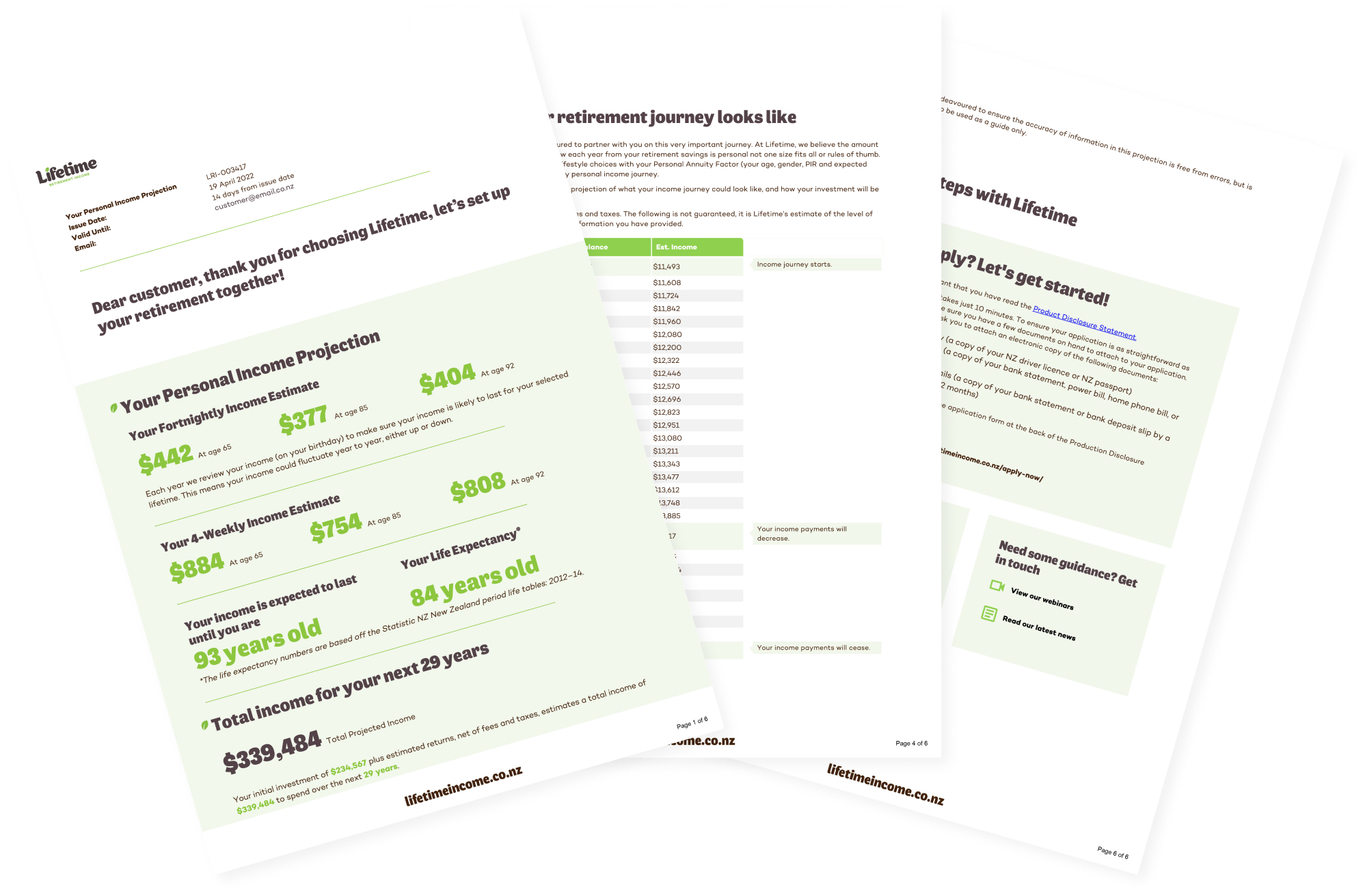
How much could you get a fortnight with Lifetime Home?

What Treasury has to say
Alongside these political views we have Treasury saying it believes NZ Super won’t be affordable unless we increase the age of eligibility to around 72. The Organisation for Economic Co-operation and Development (OECD) is recommending we link the age of eligibility to life expectancy, implying it would increase over time.
It has also suggested we change the way KiwiSaver is taxed. At present, we get no tax relief from contributions, but withdrawals are not taxed. The OECD’s suggestion is we reverse this, giving tax breaks for contributions and then taxing withdrawals. This would offer an incentive for savers and result in less tax being paid overall as tax rates in retirement are generally lower. National has dismissed this as being too disruptive right now.
The down sides
While something needs to be done to solve the burden of NZ Super on the economy, there are negative consequences for the proposed solutions.
Increasing the age of eligibility unfairly disadvantages Māori and Pasifika people who have a much lower life expectancy, and people of all ethnicities whose work involves physical labour, such as tradespeople.
Raising the minimum contribution for KiwiSaver and/or making KiwiSaver mandatory, places increased financial pressure on those on lower incomes.
Introducing means testing penalises people who have saved and invested over their working lives to build up their retirement capital. It’s also a disincentive for people to continue working once they begin receiving their pension.

What about a capital gains tax?
Alongside KiwiSaver and NZ Super policies, the issue of capital gains tax also impacts on retirement income. For many Kiwis, investing in property has been a popular strategy for building a retirement portfolio – which would be impacted by such a tax. Both the Labour Party and the Green Party have indicated they support some form of capital gains or wealth tax.
Should any policy changes be implemented, there will undoubtedly be a transition period during which changes will be made incrementally, or only after a certain date in the future. Those already over 65 will clearly not be impacted by an increase in the age of eligibility.
Time for a grown-up conversation
Jane Wrightson, the outgoing Retirement Commissioner, has weighed in on retirement policies as a parting shot. In a recent interview, she stated that what she really wants is for there to be “a grown-up conversation around what the next 30 years of a retirement income system looks like.” Wrightson says that needs to be looked at “with evidence and with independence, and with a genuine commitment, from at the very least, the major parties, to say ‘yes we will do this’". I couldn’t agree more and this needs to happen with urgency.
Project your retirement income.

Written by:
Liz Koh
Liz Koh is a money expert who specialises in retirement planning.
Invest with Lifetime for a retirement income managed for living.