Retirement Life
26 August 2026
Could bikepacking be your next retirement hobby?
New Zealand is experiencing a bikepacking boom, and retirees are at the heart of it. And the great news is – you don’t have to be uber fit to get into bikepacking too; almost anyone can get involved.
Bikepacking (formerly known as fat-tired touring) is essentially backpacking by bike. Riders carry what they need, travelling at their own pace and enjoying the journey as much as the destination. While some might tackle more technical multi-day adventures, others can start with a simple overnight trip close to home.
Whatever end of the spectrum you’re at, it’s a rewarding way to get out, see the country and improve fitness.
Bikepacking expert and author of Bikepacking Aotearoa, Jonathan Kennett, says there are lots of people in their 60s getting into this pastime. One of the oldest people to ride Tour Aotearoa from one end to the other in less than a month was 76.
"It's becoming more and more common to see retirees out bikepacking around New Zealand," he says.
"It's a way of regaining a bit of fitness, but also reconnecting with something you loved doing when you were a kid. It makes you feel young."
Not just for the uber fit
One of the biggest reasons bikepacking has become more accessible is the rise of e-bikes.
For those who haven't cycled regularly for years, having that bit of electric assistance can make longer trips feel more realistic. Riders still get plenty of exercise, but without the worry that every hill will be a struggle.
But planning around battery charging needs to be considered.
"(Cyclists) become very familiar with the range of their batteries and how many kilometres they can do,” says Kennett. "After one or two trips, it's just something you manage, along with eating and finding accommodation."
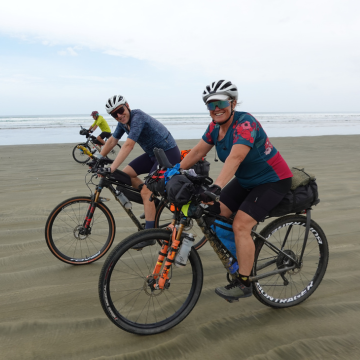
Bikepacking along 90 Mile Beach
"It's becoming more and more common to see retirees out bikepacking around New Zealand [...] It's a way of regaining a bit of fitness, but also reconnecting with something you loved doing when you were a kid. It makes you feel young."
—Jonathan Kennett (Author of Bikepacking Aotearoa)
A gentler way to explore
Bikepacking shares some similarities with tramping, but Kennett says it’s a bit gentler on an ageing body.
"You're not carrying the weight yourself. The bike is bearing the weight," he explains.
Unlike a multi-day hike, many cycle trails pass through towns and settlements, making it easy to stop for coffee, a meal or a comfortable night's rest. This means you don’t have to carry a tent and all your food.
"One of the real delights of bikepacking is that when you do get to a café, that hunger you've worked up means the food tastes better than you can imagine," Kennett says.
The main cycle trails can be combined with quiet off-road backcountry roads – roads that can have as few as 10 cars a day on them – to make loop trips. Kennett has detailed these in his Bikepacking Aotearoa book. He says these backroads feel like cycle trails.
“And you can really meet some cool people because anyone you meet on a road that's that quiet will stop and talk to you. They'll probably be a farmer,” he says.

Start simple
For anyone considering giving bikepacking a go, Kennett suggests starting with easier trails and not overestimating your abilities.
New Zealand's cycle trails are graded from one to five. Beginners, especially those who haven't ridden for many years, should stick to grade one trails.
For example, Aucklanders could consider starting on the Hauraki Rail Trail. In the South Island, the Otago Central Rail Trail provides a great introduction.
He says there are three main ways to bikepack.
- Unsupported: Travelling independently, carrying all your own gear and looking after yourself en route.
- With support crew: A group of friends go together and might have a campervan for support. One person is designated driver, or else the group takes turns driving the support vehicle.
- Joining an organised tour: Accommodation, luggage and logistics are all organised for you. Organised tours overseas are also becoming popular, particularly in places like Samoa, Australia and of course, Europe.
Jonathan Kennett’s top bikepacking tips:
Start with an overnight trip to see if bikepacking is for you.
Buy a more comfortable bike seat. “The most significant pain point for somebody riding a bike is generally their posterior,” Kennett says. Typically the seat that comes with your bike won’t cut it, so invest in a new one.
Prepare yourself with regular short rides. Time in the seat is more important than speed, Kennett says.
Remember to start on a grade one trail: If you haven't done any cycling for 40 years and you're in your 60s or 70s, don't go near a grade three, Kennett recommends. "It will scare you," he says.
Key resources
Kennett's books, Bikepacking Aotearoa and Classic New Zealand Cycle Trails, provide loads of information about trails to try, gear you need, and bike set-up – all the details you need to make your adventure go smoothly.
The NZ Cycle Trail website also has a section on bikepacking, including information on the best trails in the country, what to pack and choosing a bike.
Spring could be the perfect time to get training.
Imagery provided by Jonathan Kennett, Bikepacking expert and author of Bikepacking Aotearoa
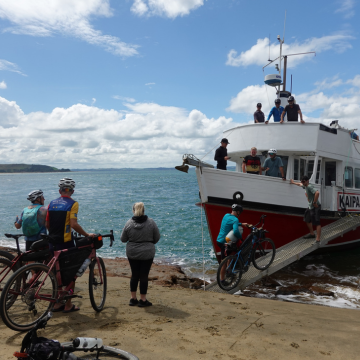
Bikepacking with a tour group at Kaipara Harbour
How much could you get per fortnight?


Written by:
Sonia Speedy
Sonia Speedy has been a journalist for over 20 years, working in newspapers, magazines and radio. She also runs an online platform for parents at familytimes.co.nz. She lives on the Kāpiti Coast with her young family and loves writing stories that help make people's lives easier.
Invest with Lifetime for a retirement income managed for living.