News
11 September 2026
Ageing in place: planning for a future that may cost more
A new report on the future of aged care makes for sobering reading. It warns that unless the existing system is overhauled, ageing with dignity and choice cannot be taken for granted. It predicts a potential shortage of more than 9,000 residential care beds by 2037/38 if something isn’t done, and the cracks are beginning to show now.
But repairing the system doesn’t come cheap. New Zealand needs to prepare for an older population, rising demand for care services and significantly higher costs. For advisers and retirees alike, that means factoring future aged care needs into financial planning is looking increasingly important.
The report
The Government set up the Aged Care Ministerial Advisory Group to provide independent advice and recommendations on the New Zealand aged care system, and it presented its report, A place to grow old: Securing the future of aged care, last month (August 2026).
It warns that if the way aged care costs are shared between the government and the public isn’t “rebalanced” soon, it will become unaffordable, with demand expected to drive up aged care service costs by almost 90% over the next 20 years.
The report doesn’t pull its punches, saying there are currently not enough residential care beds for the number of older people who will need them, and not enough workforce to look after them. It recommends a more shared-cost approach between the public and government.
The group, led by the Hon David Cunliffe, calls for major structural reform and puts forward 40 recommendations for change, aimed at creating a more “integrated care pathway”, greater support for people to live at home for longer and a new approach to how people contribute towards their care costs, along with targeted funding to help build more standard residential beds.

Cracks showing now
‘While many older people receive good care, pressures have been building for years: we now have a system that is outdated and unaffordable,' Cunliffe says.
“The cracks are starting to show in bed shortages, some services closing their doors, and some carers unable to cope. As our population ages, those pressures will only multiply.
‘These shortages would mean older people suffer and families struggle, general practices are strained, and hospitals are overcrowded, leading to longer waitlists and poorer health outcomes across the country. This is not the future New Zealanders want,’ Mr Cunliffe says.
The Advisory Group estimates the changes it recommends would improve health and wellbeing outcomes and avoid unnecessary growth in taxpayers’ costs by just over $830 million per year by 2037/38.
‘Many older people want to remain independent and close to family, while having the confidence that formal care will be there if they need it. This means scaling and enhancing in-home care, better support for carers and whānau, and creating a pipeline of new beds,’ Mr Cunliffe says.
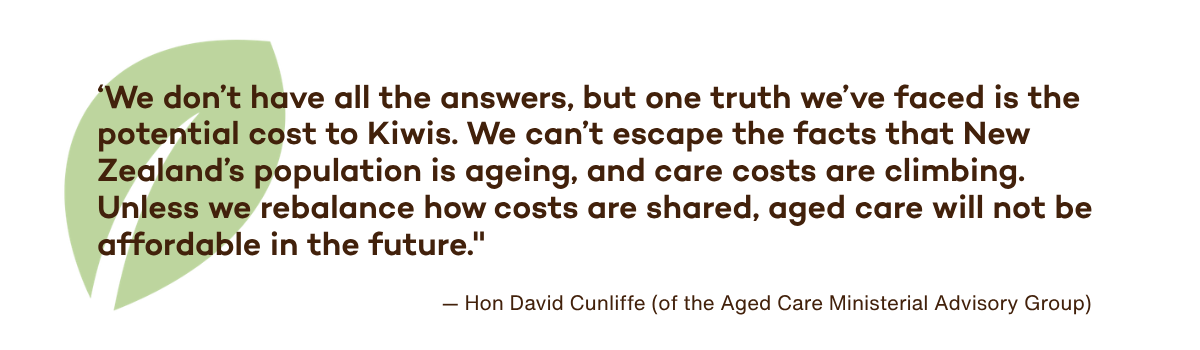
‘We don’t have all the answers, but one truth we’ve faced is the potential cost to Kiwis. We can’t escape the facts that New Zealand’s population is ageing, and care costs are climbing. Unless we rebalance how costs are shared, aged care will not be affordable in the future. Those who can contribute towards the costs of their own care should do so, fairly and transparently, so the system is still there for our children and grandchildren when their time comes.”
Enabling ageing in place
One of the report’s strongest themes is supporting more people to age in place through stronger in-home services, better support for carers and a more connected care system.
For many, ageing in place is the preferred option – one that keeps them closer to friends and family, the places they know, and the medical and professional services that know them. For others, it may be more challenging.
Whatever the driver, many may also want to top up the services they are provided to enable them to live at home and age in place more comfortably. This is where Lifetime Home can be a useful tool for those who have spent a lifetime paying off their home but find themselves cash poor in older age.
For some, the additional income Lifetime Home can help generate could pay for a cleaner, a gardener, or other forms of assistance.
By accessing that equity in the home – without having to take on debt or incurring compounding interest – individuals can have greater control over how their retirement and ageing looks. This is enabled by selling a small share of their home to Lifetime Home (for a fixed charge), in return for a reliable fortnightly income, on top of NZ Superannuation, for up to 10 years.
For clients who are asset rich but cash poor, it can be a valuable way to help bridge the gap between available income and the cost of maintaining independence as they age, in the way they would like to.
For more information on Lifetime Home, contact Lifetime Chief Marketing Officer Chelsea Devlin.
Are your clients looking to generate additional income on top of NZ Super?


Written by:
Sonia Speedy
Sonia Speedy has been a journalist for over 20 years, working in newspapers, magazines and radio. She also runs an online platform for parents at familytimes.co.nz. She lives on the Kāpiti Coast with her young family and loves writing stories that help make people's lives easier.